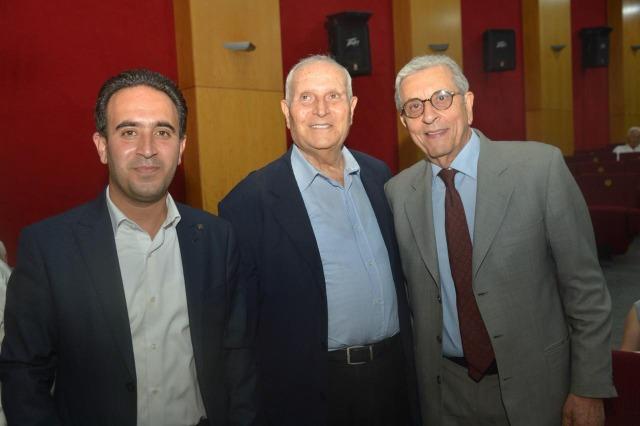
As part of his constant commitment to engaging with cultural and intellectual events in Lebanon, His Excellency the Ambassador of the People's Democratic Republic of Algeria to Beirut, Mr. Kamal Bouchama, accepted a kind invitation to attend the symposium honoring the late great Lebanese writer Suhail Idriss (1925–2008). The symposium was held on Tuesday, June 24, 2025, at the headquarters of the Association for Specialization and Scientific Guidance in Beirut.
The symposium, which bore a distinguished literary and cultural character, was initiated by the Lebanese Writers Union in recognition of the legacy of the late writer, considered one of the most prominent figures in the twentieth-century literary renaissance and the founder of Dar al-Adab, an influential Arab intellectual and literary platform.
The meeting opened with a welcoming speech delivered by Professor Wassef Sharara (a graduate of the University of Algiers) on behalf of the Association for Specialization and Scientific Guidance. He reviewed the pivotal moments in the late writer's career, noting his role in enriching the Arab cultural scene. Dr. Ahmed Mahmoud Nazzal, President of the Lebanese Writers Union, also delivered a speech on the occasion, welcoming the attendees and highlighting Suhail Idris's pioneering role in bridging the gap between Arabic and Francophone literature and establishing the foundations of an authentic critical school with intellectual and cultural influences that transcend borders.
His Excellency Ambassador Kamal Bouchama prepared a speech for this occasion, which he presented to the organizing body to be added to the honors list. He expressed his deep respect for the late writer's contributions, and considered the honoring of Suhail Idris a tribute to enlightened Arab thought and to the culture that builds bridges and strengthens our shared cultural identity.
In his speech, he said:
"When we celebrate Souheil Idris, we commemorate the life of a man who believed in free speech, who dedicated his pen and thought to the causes of his nation, and who was a living conscience of cultural Arabism. His literary project intersected with Algeria's cultural project of liberation, openness, and creative dialogue between cultures.
As a representative of a country that has always believed in the power of the word in confronting colonialism and ignorance, I find in this tribute a living testament to the continuity of that struggle, albeit with the weapons of thought and knowledge."
This participation comes within the context of Algeria's ongoing commitment, both officially and popularly, to supporting cultural causes, preserving Arab intellectual heritage, and strengthening cultural cooperation between Arab countries, given its pivotal role in building generations and preserving a collective identity.